
Diploma in Finance & Accounting (DFA)

DFA program equips students with theoretical and practical skills in finance, accounting, and related areas, preparing them for entry-level positions in various industries.
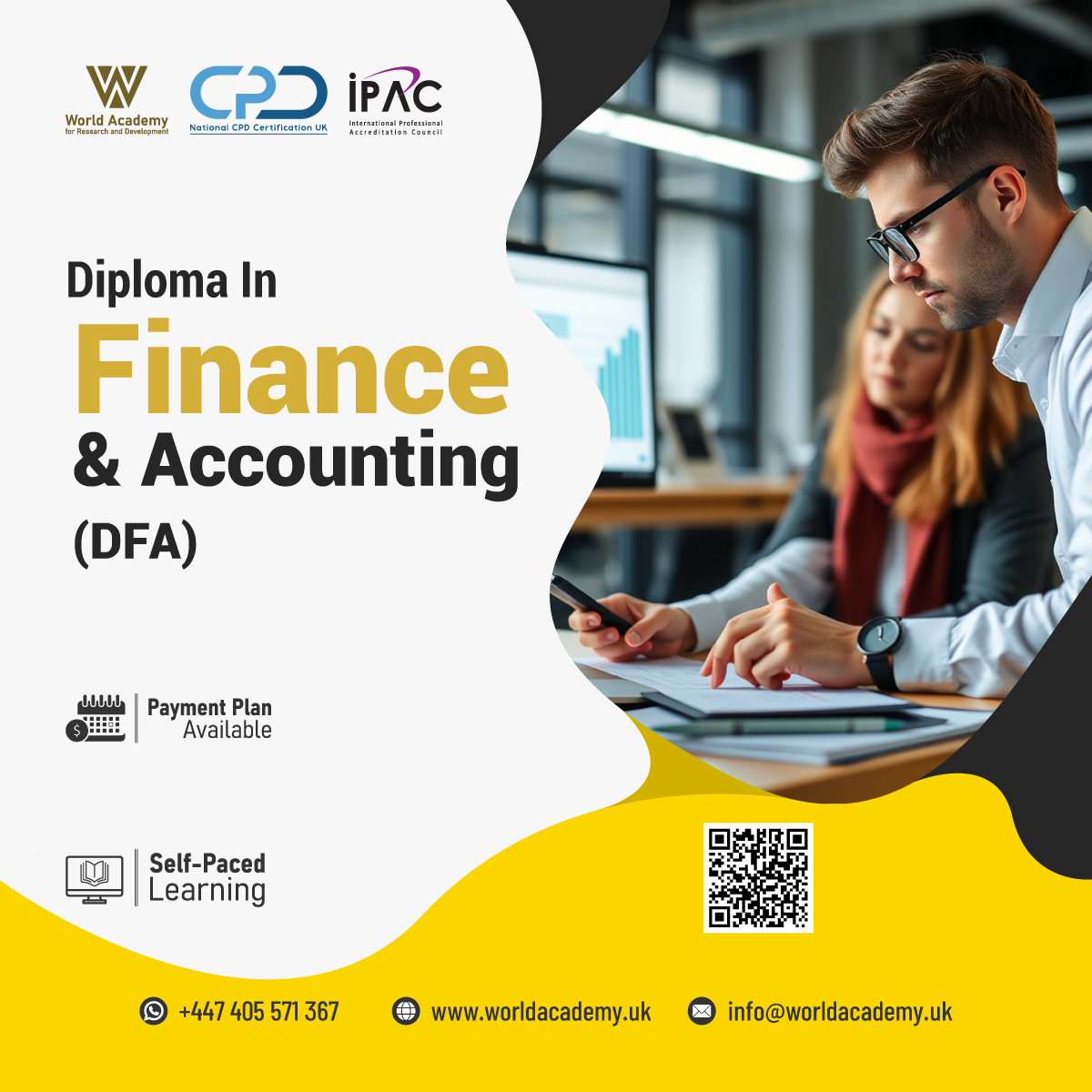
Diploma in Finance & Accounting (DFA)

The Diploma in Finance & Accounting (DFA) program is designed to provide participants with a comprehensive understanding of financial and accounting principles, essential for managing business performance and making informed financial decisions. This program covers key financial concepts such as financial statement analysis, budgeting, capital management, financial leverage, and investment decisions.


Participants will develop the ability to analyze financial statements, evaluate costs, manage cash flow, and make strategic financial decisions that align with business goals. The program also includes in-depth coverage of financial management techniques, including time value of money, break-even analysis, and capital budgeting.


The curriculum combines theoretical insights with practical applications, ensuring that participants gain real-world experience and the ability to apply their knowledge to business challenges. Upon completion, participants will have the financial and accounting expertise needed to improve business performance, enhance profitability, and make sound financial decisions.


    • Understand the Fundamentals of Managerial Economics – Develop a solid foundation in business and economic decision-making.
    • Analyze Financial Statements – Learn how to assess the financial health of an organization.
    • Manage Costs and Control Budgets – Develop methods to monitor costs and improve profitability.
    • Apply Investment Decision Rules – Learn how to evaluate and select investment opportunities.
    • Understand the Time Value of Money – Develop skills to calculate present and future value for financial decisions.
    • Manage Financial Leverage and Capital Structure – Learn how to use debt and equity to optimize business performance.
    • Develop Capital Budgeting Techniques – Learn how to assess long-term investment opportunities.
    • Optimize Cash Flow Management – Develop strategies to improve cash flow and liquidity.
    • Manage Corporate Income Tax – Understand tax planning and compliance strategies.
    • Make Dividend and Financing Decisions – Learn how to create effective dividend and financing policies.
  • Unit-1: Introduction to Business

    M-1: Managerial Economics

    M-2: Generational Forms of Business


    Unit-2: Financial Accounting & Cash Flow

    M-3: Organization, Objectives & Decisions

    M-4: Financial Statements, Analysis, and Information


    Unit-3: Costing and Budgetary Control

    M-5: Understanding Costs

    M-6: Break-Even Analysis


    Unit-4: Management Accounting

    M-7: Budgetary Control

    M-8: Cash Flow Statement


    Unit-5: Decision-Making Techniques

    M-9: Corporate Income Tax

    M-10: Time Value of Money


    Unit-6: Corporate Finance

    M-11: Investment Decision Rules

    M-12: Capital Budgeting Techniques


    Unit-7: Cost of Capital and Debt Fund

    M-13: Operating and Financial Leverage

    M-14: Cost of Debt


    Unit-8: Corporate Tax and Dividend Policy

    M-15: Cost of Capital

    M-16: Dividend, Policy, and Decision Making


  • Exam Method:
    Number of Exams: 08 (Each unit has One Exam)

    • Number of Questions: 20 MCQ Questions + 2 Written Questions (Each Exam)
    • MCQ Question Mark: 2 * 20=40
    • Written Question Mark: 30 * 2= 60
    • Exam Duration: 60 Minutes
    • Total Marks: 100 (Each Exam)
    • Pass Mark: 50%
  • Upon completing the program, participants will be able to:

    • Develop and analyze financial statements to evaluate business performance.
    • Apply cost management techniques to improve profitability.
    • Manage budgets effectively to control business expenses.
    • Assess and select investment opportunities based on financial analysis.
    • Implement capital budgeting techniques to support business growth.
    • Develop financing strategies using debt and equity.
    • Manage cash flow to improve liquidity and business operations.
    • Ensure compliance with corporate income tax regulations.
    • Develop dividend policies to maximize shareholder value.
    • Use financial leverage to enhance business performance and reduce financial risks.

This program is endorsed by International Professional Accreditation Council – Singapore [www.ipacglobal.org]


    • Features:
      Duration: 6 Months
      Modules: 32
      Video Materials: Yes
      Mode of Learning: Self-Paced

      Assignment: 

      • Total Assignments: 
      • 1 Pre-Course Assignment (Learning Purpose)
      • 1 Capstone Project
        • Total  Marks: 300
        • Pass Mark: 50%
    • 16 Practical Focus Modules
    • 1 Reference Book
    • Post Completion:
      • Electronic Certificate
      • Digital Badge via Credly.com
      • Printed Certificate Available
      • Printed Transcript  Available
    • Financial Analysis and Reporting
      • Competence in preparing and interpreting financial statements.
    • Cost Management
      • Proficiency in controlling business costs and improving efficiency.
    • Investment Analysis
      • Skill in evaluating and selecting investment opportunities.
    • Budgeting and Forecasting
      • Competence in creating and managing business budgets.
    • Capital Structure Management
      • Ability to manage financial leverage and optimize capital structure.
    • Tax Planning and Compliance
      • Skill in understanding and managing corporate income tax obligations.
    • Cash Flow Management
      • Expertise in managing cash flow and liquidity.
    • Strategic Financial Decision-Making
      • Ability to align financial decisions with business objectives.

GBP: 350.00

GBP 450.00
Register Now

Duration

06 Months

Course Type

Self Paced

Language

English